A GRAPH BASED APPROACH FOR EFFECTIVEINFLUENCER MARKETING

AHSAN TAHIR’S QUIET DISRUPTION

AUTHORS : Salman Ansari, Muhammad Ahsan Tahir and Shahwaiz Bukhari
Techlets Pvt. Ltd.

ABSTRACT

We present a novel graph-based approach to find the optimal set of influencers from a large pool of influencers. The goal is to select minimum number of influencers that can reach the desired audience. In order to find such a set, one has to compute the reach of all possible combinations of available influencers resulting in complexity of order O (2 n ). Our proposed greedy approach selects the pair of influencers that results in highest reach at every iteration reducing the complexity to O(n 2 ). Our work is complimented with analysis of 550 Instagram influencers and over 100,000 post. After the analysis, we concluded that influencers who prefer quality over quantity receives better engagement. Influencers sharing 3 posts per week and posts with caption length of over 500 characters relatively received better engagement numbers.

KEYWORDS

Graph Analytics, Influencer Marketing, Social Media Influencer, Greedy Algorithm

1. INTRODUCTION

Graph Analytics, Influencer Marketing, Social Media Influencer, GreaWith 3G/4G telecom services now common and offered at among the world’s most affordable rates in Pakistan, 67 million locals have mobile broadband internet access. According to a Gallup & Gillani poll, 48% of internet users consume online content daily[1]. One content producer category is the “Social/Digital Influencer” who are followed by ‘fans’ numbering from a few thousands (micro-influencers) to millions (celebrities). Their digital content, whether pictures, videos and live streams, are delivered on digital and social channels – Instagram, Facebook, YouTube, Beigo, TikTok – and cover a wide range of genres from lifestyle, fashion, health to entertainment and comedy.Brands can use social and digital influencers to launch and manage effective organic marketing campaigns. Pakistan’s SMEs, comprising 98%+ of all companies, actively use influencer marketing as a cost-effective strategy to engage and sell in/directly to Pakistan’s online population[2], an estimated “trade” value at PKR 5 billion*/year[3]. For sellers, influencers represent an impactful and efficient outreach channel as they affect purchase behaviors and choices, brand perceptions and even the national narratives of ~30% of Pakistan’s population[4].

A key challenge is to optimize influencer marketing budgets by cost-efficiently identifying the most optimal set of influencers who can effectively reach desired audiences, from prospects, buyers to promoters. To only consider an influencer’s number of followers is misleading as there is an underlying overlap between the followers of influencers who have contextual similarities – that is two influencers with the same city, age group, same genre/category and content themes are likely to appeal to the same people following them both. To solve this overlap problem, we are focusing on one of the most influencer-driven social networks, Instagram. We propose a Greedy Algorithm to rationalize the minimum number of influencers to attain the best reach.
Our proposed solution is supported by analyzing500+ influencer profiles and over 100,000 Instagram posts to establish trends and benchmarks for influencers. For example; the average post’s engagement is 3.28% of total followers. Based on our findings those influencers who consistently had a higher engagement rate, appeared to emphasize on quality over quantity, as posts had detailed and meaningful caption length swith frequency of up to three posts/week. The key constraint to our approach is to have a comprehensive list of followers of all the influencers as overlap cannot be found between the influencers without the complete list of all the users following the influencers.

2. RELATED WORK

Influencer marketing is described as the “art and science of engaging people who are influential online to share brand messages with their audiences in the form of sponsored content” [5].Social media influencers who are responsible for influencer marketing are the third-party endorser responsible for shaping attitude of the audience towards the brands through videos, blogs and social media [6].
To solve our defined problem, we explored graph-based solutions as Influencers-Followers relationships that can best be explained in graphical representation with nodes as Influences/Followers and edges as interactions between them. We examined several different techniques and tried to model our problem on them. Bhamaikar and Rao [7] worked on identifying cliques using degree and connectivity constraints, we tried to model our problem and modify their approach to create and analyze cliques of followers to find the true reach of all influencers but realized that clique detection was not the right representation of the problem we were working to solve. Leskovec, Lang, Dasgupta, Mahoney [8]employed approximation algorithms to identify community structures in large social networks, we intended to employ their approach to estimate true reach of Influencers by identify communities of followers. Leskovec, Backstrom and Kleinberg [9] suggested to monitor information flow using content of the information like hash tags or memes. Sawhney, Prasetio and Paul [10] combined graph structure and semantic understanding of the text for community detection. We worked to identify overlapping followers by monitoring the content they post on their profiles but it is too much of an overhead to monitor the content of all followers of the influencers.

To the best of our knowledge and research, we were unable to find any body of work directly related to our problem. We therefore propose novel approach to solve the problem of finding effective influencers by introducing the “Greedy Algorithm”.

3. KEY DEFINITIONS:

3.1. Influencers:

Instagram users with a substantial following, engagement rates, working with brands or creating their own content for the purpose of advertisement, promotions and outreach.

3.2. Overlapping Followers:

The followers of an influencer who also follows other influencers. If user ‘A’ is following two influencers IA and IB than ‘A’ is considered the overlapped follower of IA and IB.

3.3. Reach:

The maximum number of users who can be reached with a selected influencer. For any influencer, reach is the total number of its followers.

3.4. True reach of influencers:

The number of distinct users who can be reached with selected influencers. For two influencers IA and IB,it is calculated as:

 𝑇𝑟𝑢𝑒𝑅𝑒𝑎𝑐ℎ𝑜𝑓𝐼𝐴𝑎𝑛𝑑𝐼𝐵 = (𝑅𝑒𝑎𝑐ℎ𝑜𝑓𝐼𝐴 + 𝑅𝑒𝑎𝑐ℎ𝑜𝑓𝐼𝐵) − 𝑂𝑣𝑒𝑟𝑙𝑎𝑝𝑝𝑖𝑛𝑔𝐹𝑜𝑙𝑙𝑜𝑤𝑒𝑟𝑠

3.5. Engagement:

The total activity received on any post, defined as:
𝐸𝑛𝑔𝑎𝑔𝑒𝑚𝑒𝑛𝑡 = 𝑆𝑢𝑚𝑜𝑓𝐿𝑖𝑘𝑒𝑠 + 𝑆𝑢𝑚𝑜𝑓𝐶𝑜𝑚𝑚𝑒𝑛𝑡𝑠

3.6.Influencer Node:

The nodes in the graph representing influencers.

3.7. Follower Node:

The nodes in the graph representing followers.

4. PROBLEM STATEMENT

Marketing agencies can select from their in-house directory of influencers talent to be allocate to a marketing campaign. As one Instagram user can follow several users on the platform, there is a high probability that there will be overlapping of followers between the influencers (a follower following more than one influencer), hence the actual reach of the selected influencers will be far less than the sum of total number of their followers.
Every brand wants to optimize marketing spend. They want to continuously improve reach metrics by using the right combination of influencers to maximize reach using minimal budget spend.
Our sample dataset [Section:Dataset] had an average overlap rate of 11% between followers of two influencers. As the number of selected ‘similar’ influencers increased, this overlap rate increased making it an even bigger issue in terms of increasing unique reach. To as certain this problem’s magnitude, we considered the following example:
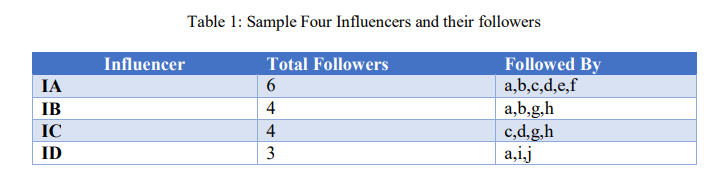
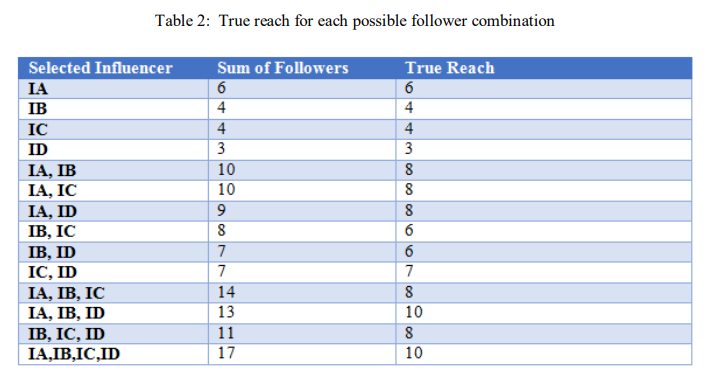
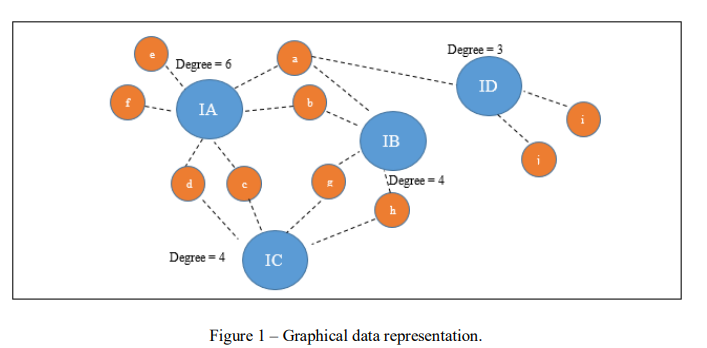
A marketing agency selects four influencers (IA, IB, IC, ID) registered with them, but their total in-house database could be in the millions. The dynamics of these influencers are illustrated in Tables 1 showing the followers, Table 2 tallying the true reach and Figure 1 which shows the graphical representation.
Sample Four Influencers and their followers
True reach for each possible follower combination
Graphical data representation

Larger nodes represent influencer-nodes while smaller nodes represent follower-nodes.

From the above scenario, influencer IC’s followers can all be reached with influencers IA and IB so the addition of influencer IC does not increase the total reach. The impact of a brand’s selection constrained by budget if they limit by having:

  • Two influencers: choosing IA and ID will be more economical over the obvious choice of IA-IB or IA-IC, as the true reach of IA-ID is 8 which is the same as the true reach of IA-IB and IA-IC and more than the true reach of IB-IC that is 6, as ID has less number of followers than IB and IC and should charge less than the other two (Ref Figure 1 and Table 2), an improved reach by 33%.
  • Three influencers: the combination of IA-IB-ID will be more efficient than IA-IB-IC despite the sum of total followers of IA-IB-IC (14) being more than the total followers of IA-IB-ID(13) as the true reach of IA-IB-ID is 10 while that of IA-IB-IC is 8, an improved reach of 25%.
In the real world, the graph of all the available influencers and their followers, contains millions of nodes and edges so to find the best solution, one will have to explore all the possible combinations resulting in the complexity of O (2 n ).

5. OUR SOLUTION

To solve the problem of reaching the maximum audience by selecting specific influencers from a set of influencers, we propose a Greedy Algorithm. The heuristic is to keep combining pair of influencers from a set of available influencers that generates the maximum reach until the required reach or set of influencers is obtained. We used SNAP-Stanford Network Analysis Project[11] to generate and manipulate the graph.

5.1. Parameters

The proposed algorithm allows users to set following parameters, or alternatively the algorithm can select a default value.

5.1.1 Target Reach

Total audience the brand wants to target. The set of influencers under consideration should have total number of unique followers equal to or greater than the targeted reacha

5.1.2 Macro Influencer Threshold

Minimum number of followers required by the influencer to be considered a Macro Influencer. The system uses a default value of 300,000.

5.1.3 Micro Influencer Threshold

Minimum number of followers required by the influencer to be considered a Micro Influencer. The system uses a default value of value is 100,000. Any influencer having followers between Micro Influencer Threshold and Micro Influencer Threshold is considered Micro Influencer

5.1.4 Number of Macro Influencers

The maximum number of macro influencers who can be part of selected influencers.

5.1.5 Number of Micro Influencers

The maximum number of micro influencers who can be part of selected influencers.

5.2. Methodology

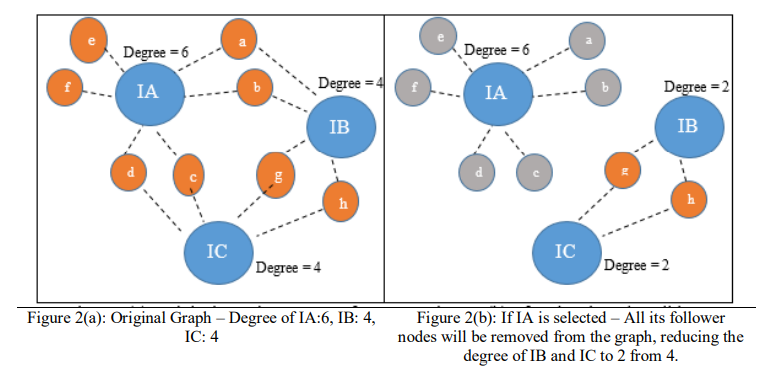
The goal is to manipulate the influencer graph so that the sum of degrees of the influencer nodes produces the true reach of the influencers. To obtain the true reach of two influencers, a two-step process was repeated until two nodes are selected:

  • After selecting the first influencer node, we removed all the nodes representing followers (follower nodes) of the selected influencer from the graph.
  • (2) The degree of all the influencer-nodes that were connected with the removed follower nodes will decrease ensuring that overlapping follower nodes between the selected influencers are considered only once. (Ref: Figure 2(a) and Figure 2(b))
Note, before removing the nodes from the graph, the degree of the influencer under consideration is stored for future processing.
Original Graph
With reference to the example in Figure 2, the influencer IA degree that is 6 is stored and a, b,c,d,e,f are removed from the graph. After removing the nodes, the sum of degree of influencer IA and any other influencer will result in the true reach of the both influencers, as the overlapping nodes are only considered while storing the degree of influencer IA.

5.3. Algorithm

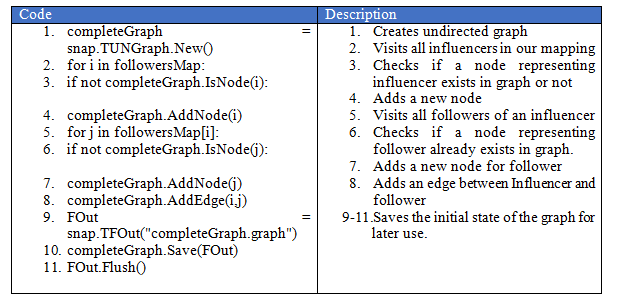
The first phase of our algorithm is to pre-process and transform the data into a structure that can generate a graph. We create an Influencer dictionary as keys and a complete list of all their followers as the value.

For the example in Figure 2A, our follower Map will be:
followerMap = {‘IA’:[a,b,c,d,e,f], ‘IB’:[a,b,g,h], ‘IC’:[c,d,g,h]}
Once we have the follower Map an undirected graph as represented in Figure(1) is created, using SNAP.
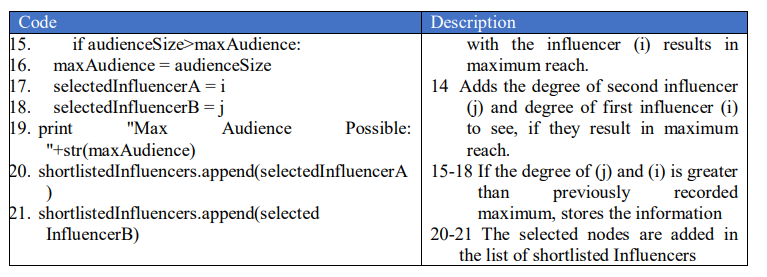
Code
The main algorithm is summarized in the following steps:
  • Select an influencer node (i).
  • Store the degree of influencer node (i) and remove all its follower nodes from the main graph. The degrees of all influencer nodes sharing the removed follower nodes are updated.
  • Visit every other influencer node, add its degree to the degree of influencer node (i), and find the pair that results in the highest reach (i.e., the highest sum of degrees). Record the reach value and the selected pair.
  • Restore the graph’s initial state and repeat steps 1 to 3 for each influencer node.
  • Select the pair that results in the highest reach. Store the reach and remove all their follower nodes from the graph. Update the graph’s initial state to reflect this removal.
  • Repeat steps 3 to 5 until the targeted reach is achieved or all influencer nodes have been selected.

5.3.1 Finding the first influencer pair
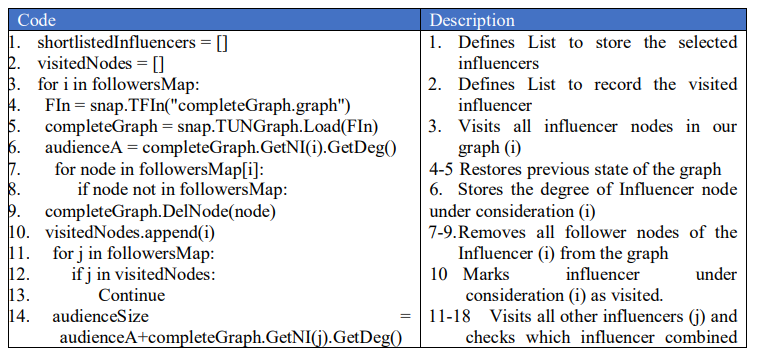
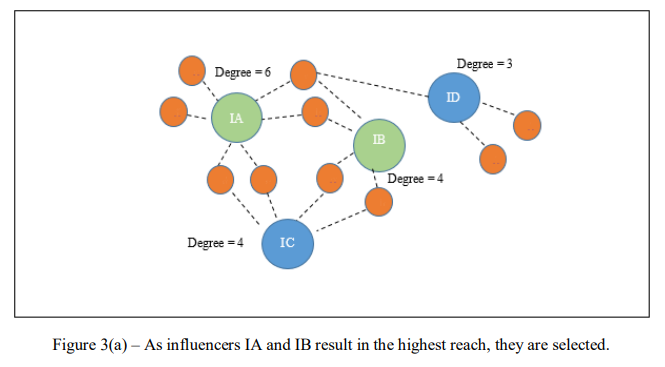
After creating the graph in Figure 1, the first step is to find the initial two influencer nodes that will result in highest reach is shown in Figure 3a.
5.3.1
5.3.2-2nd
5.3.1-3rd

5.3.2 Update Graph States after Initial Influencer Selection
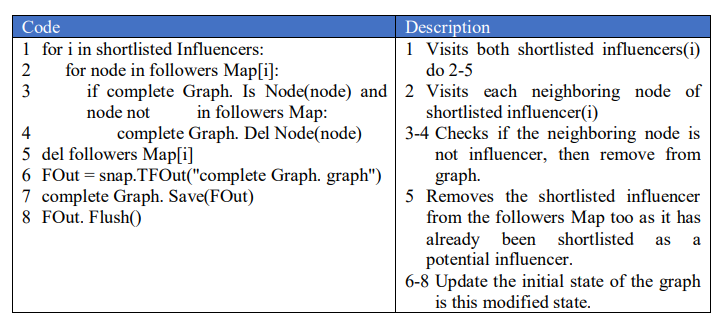
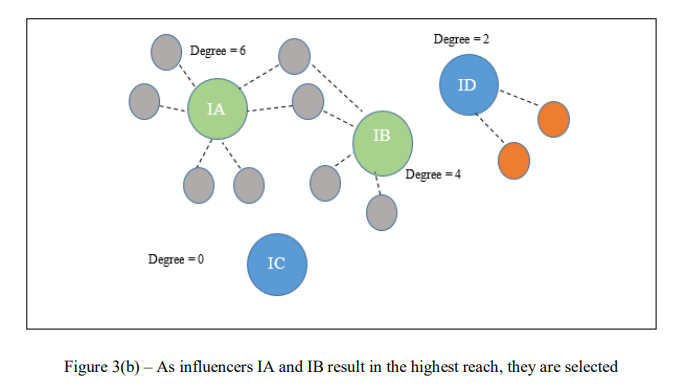
Once the initial nodes are selected, the sum of their degrees is stored as max Audience, the maximum Audience that can be reached after selection of these two influencer nodes. All the follower nodes are removed from the graph and the graph’s initial state is updated to this new state as shown in Figure 3(b).
5.3.1-4th
5.3.1-5th

5.3.3 Iteratively selecting influencers to achieve desired reach
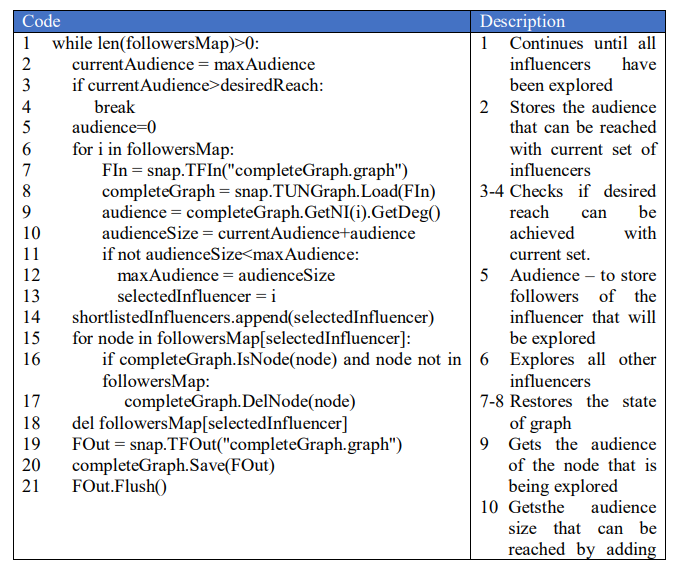
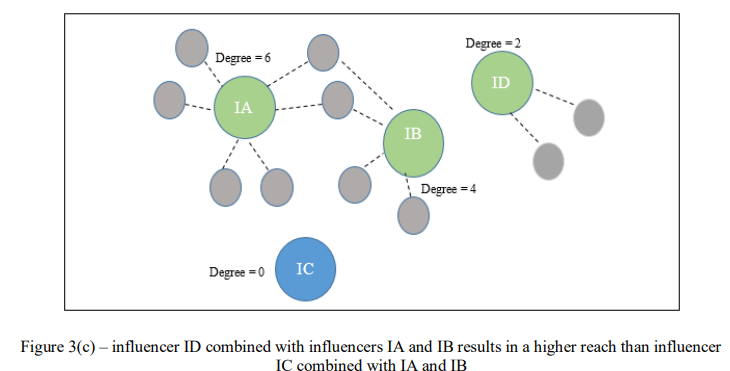
Once the initial pair of influencers is selected, the merged pair is compared with every other remaining influencer to measure which of the remaining influencer, if merged with selected influencers, will result in maximum reach. If such an influencer is found, it is merged with already merged influencers. The process continues until the desired reach is achieved or all influencers have been visited, as shown in Figure 3(c).
5.3.1-6th
5.3.1-7th
5.3.1-8th
Once the script is completed, the variable shortlisted Influencers will have the complete list of all the shortlisted influencers. This general algorithm, run within the script, is further updated to cater for useful parameters, for example:
  • The number of followers and influencer should be categorized as either a macro- or micro-influencer.
  • The total number of macro- and micro-influencers who can be part of the final list of shortlisted influencers.

These parameters are important to optimize the results as per the brand’s budget. View the
complete python script at: bit.ly/2X9lalS

5.4. Implementation with High Performance Computing
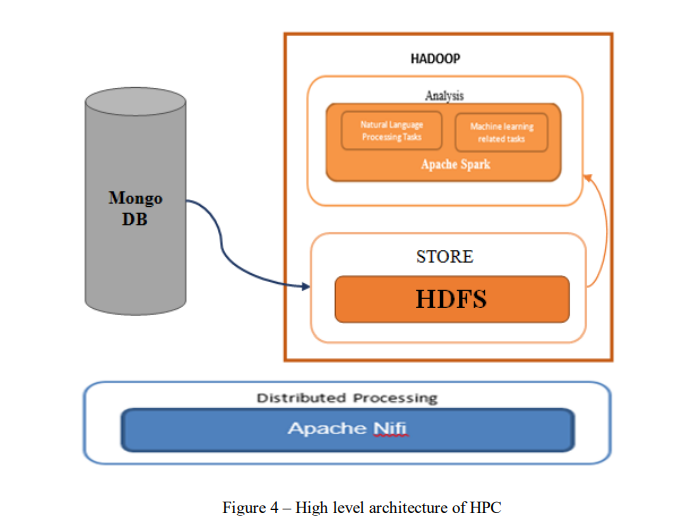
In order to make our proposed algorithm computational feasible, High Performance Computing (HPC) environment can be employed. We designed a complete pipeline using Nifi to ingest data from our database into Hadoop and calculate the reach of all influencer pairs that is needed at each iteration in parallel. Based on the results of these parallel computations, the influencer is selected that results in highest reach when combined with set of selected influencers see Figure (4).
5.4

5.5. Dataset

In order to make our proposed algorithm computational feasible, High Performance Computing (HPC) environment can be employed. We designed a complete pipeline using Nifi to ingest data from our database into Hadoop and calculate the reach of all influencer pairs that is needed at each iteration in parallel. Based on the results of these parallel computations, the influencer is selected that results in highest reach when combined with set of selected influencers see Figure (4).

  • Public profiles including biography, number of followers, and number of people they follow.
  • Publicly available profile feeds for the last six months, including post captions and the number of likes and comments received on each post.
  • Followers list.
To keep our analysis generic and unbiased, we tried to select influencers from a wide variety of thematic areas and niches but despite best efforts, around 70% of our influencer are fashion bloggers.

6. RESULTS

Our objective was to measure the effectiveness of our greedy approach by analyzing the reach and overlap of the influencers selected by our algorithm. We were also interested in establishing the KPIs and benchmarks to measure the performance of Instagram Influencers. This section discusses all the results and observations that were made.

6.1. Followers Overlap

The average followers overlap between any two influencers in our dataset was around 11%. The highest overlap between two influencers was found to be 90% with followers 210,241 and 37,858. The lowest overlap in our dataset was 0.05% between two influencers with followers 86,485 and 11,630.
We used our proposed solution to find the set of influencers that can reach at least 1 million users from our dataset. We also set the constraint of having only 1 influencer having followers more than 200,000 in the final selected set. If our solution wasn’t used and top influencers were chosen from the dataset the desired reach could have received with 5 influencers having followers 303060, 194519, 190430, 190343 and 186984 respectively. In reality the true reach of these 5 followers is only724,302 instead of 1,065,336 (sum of reach of all influencers).
Our solution selected 6 influencers with followers 279065, 194945, 190343, 186984, 133920, 131886, 101426 respectively. The true reach of selected influencers is 1,035,474 and the reach is 1,218,568(sum of reach of all influencers) [Table 3]. It should also be noted that the influencer with highest followers in our dataset having followers 303,060 was not selected by our proposed solution as it has quite a high overlap with the followers of other influencers in our dataset.
Method Reach of Selected Influencers Followers Overlap True Reach of Selected Influencers
Selecting top influencers 1,065,762 341,460 724,302
Using Proposed Greedy Approach 1,218,568 183,094 1,035,474
Table 4 – Method is the technique used to select influencers, Reach of Selected Influencers is the sum of reach of all influencers, Followers Overlap is the number of users following more than one influencer and True reach of Selected Influencers is the number of actual unique users that can be reached with selected influencers.

6.2. Analysis of Influencer Profiles

We performed a detailed analysis of our dataset, with the objective to observe a relationship between influencers and their profile activity by analyzing the content they posted and establish benchmarks used to measure the influencers’ effectiveness.

6.2.1Average Engagement of a Post

The average influencers engagement was 3.28% with only 29 out of 550 influencers had average
engagement more than 10%, based on the influencers’ profile feed.

$$ \textit{Average Engagement}= \frac{\textit{Engagement on post}}{\textit{Total followers of the influencer}} \times 100 $$

6.2.2 Post Frequency/Week

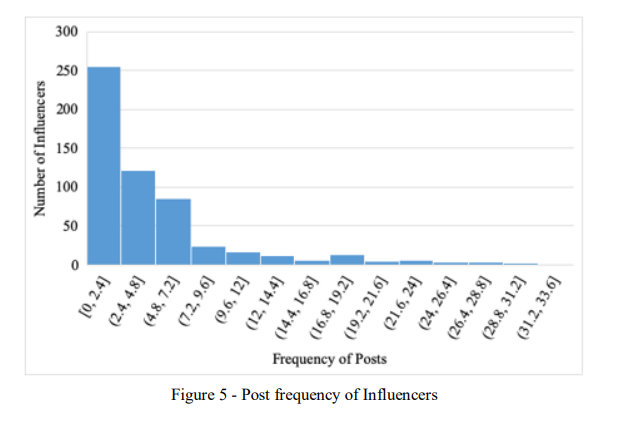
We calculated that most influencers do not post more than three posts in a week and of 550 influencers, about 25% or 140 posted more than five times/week i.e., more than one post daily as shown in Figure 5.
6.2.2

6.2.3Average Engagement vs. Post Frequency
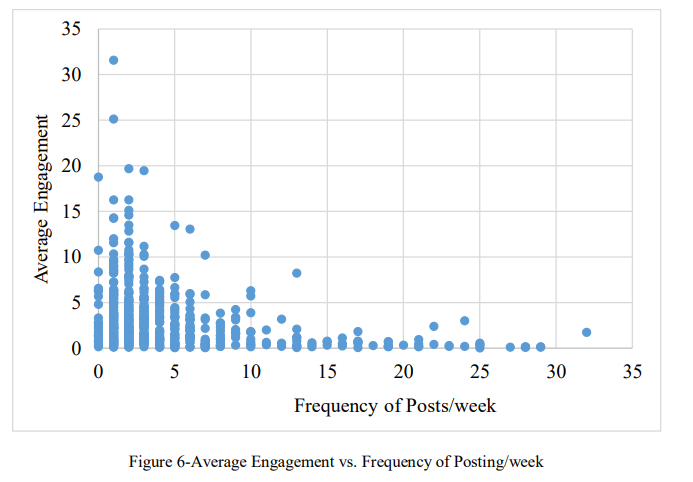
To find the optimum number of weekly posts that an influencer should make, we calculated the average frequency that resulted with the highest engagement number. There was no conclusive trend, but the data showed that the probability of a higher engagement is with less number of weekly posts i.e., influencers who posted 2 to 3 times/ week received relatively better engagement rates than influencers who posted more frequently as shown in Figure 6.
6.2.3-2nd-Media

6.2.4Average Engagement vs. Caption Length
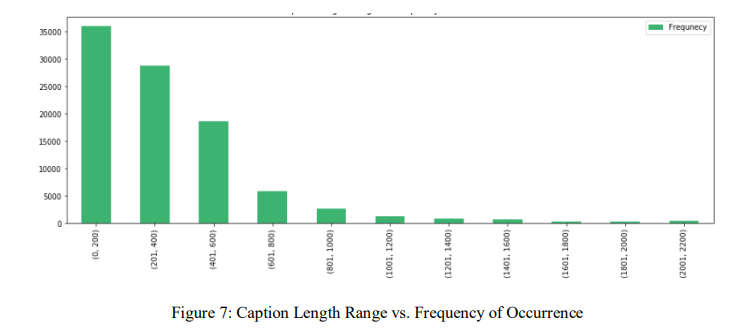
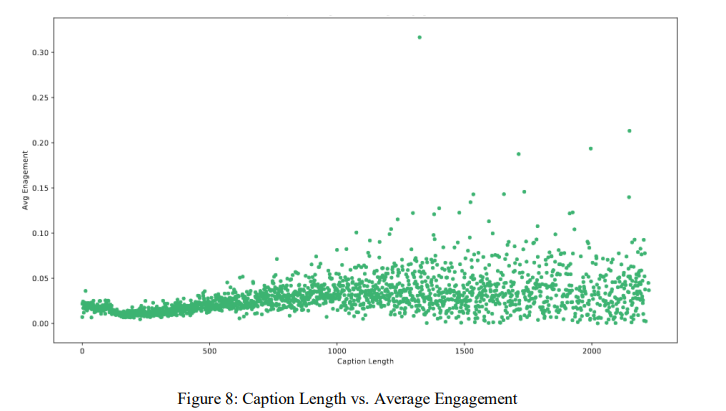
Posts with longer captions are more likely to get higher engagement than the posts with shorter caption based on analyzing 100,000+ posts by550 influencers. Around 35% of the posts analyzed had caption length less than 200 characters, around 45% had lengths between 200 and 600 characters and only 20% had caption length of more than 600 characters, as illustrated in Figure 7.
6.2.4
The analysis shows posts with longer captions are more likely to get good engagement. Based on the analysis, every post with higher than the 5% engagement rate has a caption length longer than 500 characters, as shown in Figure 8.
6.2.5

6. CONSTRAINTS AND LIMITATION

The key constraint to our approach is to have a comprehensive list of followers of all the influencers as overlap cannot be found between the influencers without the complete list of all the users following the influencers. In our case, Instagram does not support any method to automatically download or acquire the list of all the followers, so, it becomes an additional cumbersome task to obtain the complete follower lists of all the influencers registered with the agency. In order to remain up to date, these lists need to be updated rather frequently too.

7. FUTURE WORK

During this work, we proposed the Greedy Algorithm approach to calculate the optimal set of influencers to maximize reach. This work can be extended to find the optimal set of influencers that maximizes impressions, without considering reach, thereby enabling brands to reach the same audience set multiple times via different influencers. In generating the optimal influencer set, users could only restrict the number of macro- and micro-influencers. To better optimize brands’ budgets, the influencers sets can be further processed to include influencers’ compensation rates.

8. CONCLUSION

Our main goal was to propose a Greedy Algorithm for marketing agencies performing influencer marketing, to choose an optimal set of influencers to achieve higher reach by analyzing all the possible sets of their registered/accessible influencers. We showed the problem’s complexity to find the best solution i.e., the influencers sub-set who are likely to generate the maximum reach as O (2 n ). Our proposed solution finds the optimal solution in O (n 2 ).
Further, after analysis of 500+Instagram influencers and 100,000+ posts over six months, we found the average influencer engagement rate is 3.28% of their followers. The data also showed that quality content was more important than quantity to achieve higher engagement rates as influencers who posted up to three times per week and posts with caption lengthsof 500+ characters had higher engagement numbers.

9. ACKNOWLEDGEMENTS

The work presented is part of project “Big Data Analytics & Artificial Intelligence for Consumer Profiling in Pakistan” fully funded by Ignite (formerly National ICT R&D Fund). We would also like to extend our gratitude to anonymous reviewers for their valuable insights and recommendations.

REFERENCES

  • Gallup & Gilani Pakistan, “48% internet users in Pakistan claim to use social networking sites to access news at least once a day”, Gallup Pakistan, https://gallup.com.pk/48-internet-users-in-pakistanclaim-to-use-social-networking-sites-to-access-news-at-least-once-a-day/, Accessed: 6-June-2019
  • Pakistan Telecommunication Authority, “Telecom Indicators”, Pakistan Telecommunication Authority, https://www.pta.gov.pk/en/telecom-indicators, Accessed: 6-June-2019
  • Fahad Khan Niazi, “Policy & regulatory bottlenecks for digital financial services in Pakistan”, Karandaaz, https://karandaaz.com.pk/wp-content/uploads/2019/06/Policy-Brief-New-1.pdf, Accessed: 6-June-2019
  • Influencer Marketing Hub, “The State of Influencer Marketing 2019: Benchmark Report”, Influencer Marketing Hub, https://influencermarketinghub.com/influencer-marketing-2019-benchmark-report/, Accessed: 6-June-2019
  • Sammis, K., Lincoln, C., Pomponi, S., Ng, J., Gassman Rodriquez, E., & Zhou, J. (2015). Influencer Marketing for Dummies. Hoboken, New Jersey: Wiley.
  • Freberg, K., Graham, K., McGaughey, K., & Freberg, L. (2011). Who are the social media influencers? A study of public perceptions of personality. Public Relations Review.
  • Avinash Bhamikar, A., Ramchandra Rao, P. (2012). Detecting Cliques Using Degree and Connectivity Constraints. International Journal of Data Mining & Knowledge Management Process.
  • Leskovec, J., Lang, K. J., Dasgupta, A., & Mahoney, M. (2011). Community Structure in Large Networks: Natural Cluster Sizes and the Absence of Large Well-Defined Clusters. International Mathematics.
  • Leskovec, J., Backstrom, L., & Kleinberg, J. (2009). Meme-tracking and the Dynamics of the News Cycle. International Conference on Knowledge Discovery and Data Mining.
  • Sawhney, Kartik, Presetio, Marcella Cindy, & Pual, Suvadip (2013). Community Detection Using Graph Structure and Semantic Understanding of Text. Knowledge-Based Systems.
  • Leskovec, J., & Rock, S. (2016). SNAP: A General-Purpose Network Analysis and Graph-Mining Library. ACM Transactions on Intelligent Systems and Technology (TIST).

AUTHORS

Salman Ahmad Ansari Working as a Data Scientist in Techlets Pvt Ltd., Pakistan. Area of Interests: Machine Learning, Graph Theory, Data Analysis, Social Media Marketing and Natural Language Processing.

Ahsan Tahir CEO at Techlets Pvt Ltd, Pakistan. Vast Experience in Big Data Analytics
Syed Shahwaiz Bukhari Data Associate at Techlets Pvt Ltd., Pakistan. Area of Interests: Big Data Analytics, Deep Learning and Data Analysis.